

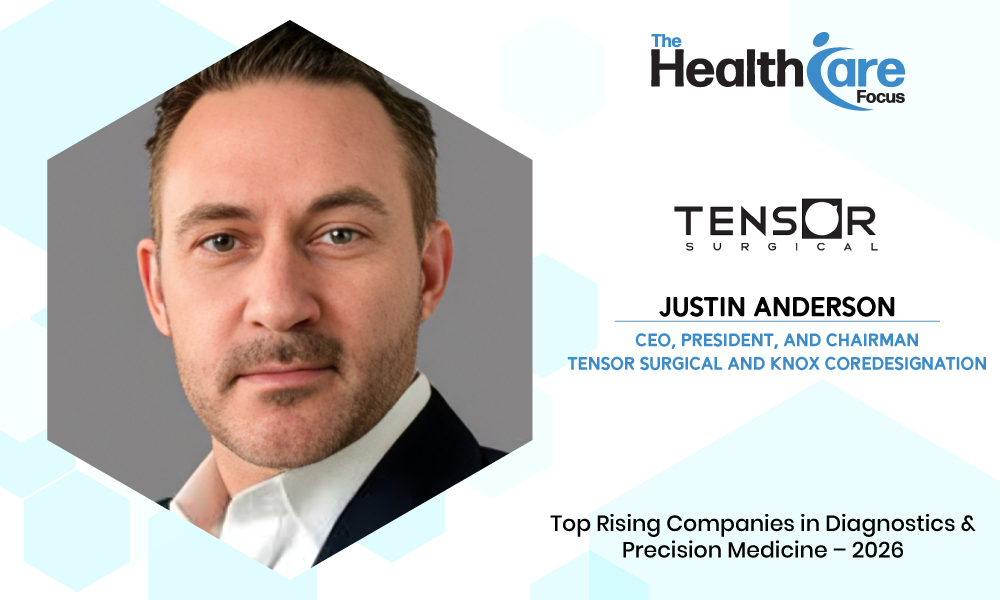
In the rapidly evolving world of medical technology, true innovation is measured not by bold claims but by real clinical outcomes. Justin Anderson, CEO, President, and Chairman of Tensor Surgical and Knox Core, has built his career on closing the gap between engineering theory and clinical reality in orthopedic surgery.
With over three decades of experience, Anderson is recognized for advancing orthopedic innovation, sports medicine technologies, and value-based healthcare solutions that improve patient outcomes while reducing costs.
Bridging Engineering and Clinical Reality
Justin Anderson’s journey into the medical device industry was driven by a clear purpose: creating technologies that deliver measurable improvements in patient care. Early in his career, he worked closely with leading orthopedic surgeons, gaining firsthand insight into how device design directly impacts surgical precision and recovery outcomes.
He identified a critical challenge—many medical devices perform well in theory but fall short in real surgical environments. This realization shaped his mission to develop solutions grounded in:
- Biomechanical science
- Clinical validation
- Practical usability in operating rooms
“Healthcare needs reliable solutions, not incremental improvements,” Anderson emphasizes.
From Professional Athlete to MedTech Leader
Before entering healthcare, Anderson was a professional athlete, achieving success as a two-time World Champion and five-time National Champion. His experience with sports injuries and access to advanced medical care gave him a unique perspective on the importance of innovation in extending athletic careers and improving recovery.
This background continues to influence his work in orthopedic sports medicine and patient-centered innovation.
Building High-Impact Healthcare Ventures
Throughout his career, Anderson has founded and scaled multiple companies across:
- Orthopedics
- Sports medicine
- Biologics
- Digital health
His ventures have resulted in:
- Two successful IPOs
- Six profitable exits
- Over $4 billion in enterprise value created
However, he defines success primarily through improved patient outcomes and long-term clinical impact.
Reinventing Soft-Tissue Repair at Tensor Surgical
At Tensor Surgical, Anderson is leading a shift in how soft-tissue injuries—such as rotator cuff tears—are treated.
Traditional approaches rely heavily on suture anchors, which can increase cost and compromise bone integrity. Tensor Surgical’s innovative platform eliminates the need for anchors, focusing instead on:
- Bone preservation
- Load-sharing biomechanics
- Reduced implant dependency
This approach supports better healing while lowering overall healthcare costs.
“Our philosophy is pro-biology, pro-mechanics, and pro-value,” Anderson explains.
AI-Driven Precision in Medical Manufacturing
A key differentiator in Anderson’s strategy is the integration of artificial intelligence into manufacturing and quality control. By implementing AI-powered inspection systems, Tensor Surgical can:
- Analyze thousands of dimensions per component in seconds
- Ensure sub-micron precision
- Improve product reliability and consistency
This level of precision ensures that devices are not only innovative but also dependable in real surgical settings.
Creating Sustainable Value in MedTech
Anderson believes long-term success in healthcare comes from meaningful innovation rather than incremental upgrades. Drawing inspiration from thinkers like Peter Thiel, he focuses on challenging traditional assumptions and building technologies that redefine standards of care.
His approach emphasizes:
- Strong intellectual property
- Clinical evidence and validation
- Economic sustainability
- Patient-first innovation
Strategic Collaboration Across Healthcare
At Tensor Surgical, innovation is driven through close collaboration with:
- Orthopedic surgeons
- Healthcare systems
- Manufacturing partners
This ensures that every product aligns with both clinical needs and economic realities, supporting the broader shift toward value-based care.
Leadership and Adaptive Strategy
Managing multiple organizations requires flexibility and strategic focus. Anderson adapts his leadership style based on business needs—balancing high-level strategy with deep technical involvement when necessary.
He draws inspiration from leaders such as:
- Elon Musk
- Jensen Huang
However, his core philosophy remains centered on building solutions that are significantly better—not just marginally improved.
Overcoming Industry Resistance
Introducing new medical technologies often requires challenging established norms. Anderson faced this when pioneering anchorless rotator cuff repair techniques, a market that previously did not exist.
Through clinical evidence, persistence, and education, he helped build acceptance for these innovations—proving that better outcomes justify change.
Measuring Impact Through Clinical Adoption
For Anderson, success is not defined by financial milestones alone. Instead, he measures impact by:
- Long-term adoption by surgeons
- Consistent clinical performance
- Improved patient outcomes over time
Sustained use in operating rooms is the ultimate validation of any medical device.
Expanding Innovation with Knox Core
Beyond orthopedics, Anderson is also advancing artificial intelligence through Knox Core. The company focuses on building an AI execution layer that standardizes how intelligence is managed and deployed at scale.
Its platform enables:
- Unified AI model integration
- Persistent memory systems
- Scalable enterprise applications
“The future of AI lies in governing intelligence, not just building models,” Anderson notes.
The Future of Orthopedic Innovation
Looking ahead, Anderson sees integration as the next major frontier—combining:
- Biomechanics
- AI-driven design
- Digital simulations and digital twins
These technologies will accelerate product development, reduce costs, and improve surgical precision.
A Leadership Philosophy Rooted in Responsibility
At the core of Anderson’s work is a strong belief that healthcare innovation carries ethical responsibility. Every device used in surgery must justify its existence through:
- Better patient outcomes
- Preservation of biological integrity
- Cost efficiency
“Innovation in healthcare carries moral weight,” he says.
Conclusion
Justin Anderson is redefining orthopedic innovation by aligning engineering precision with clinical reality. Through Tensor Surgical and Knox Core, he continues to develop technologies that improve surgical outcomes, reduce costs, and advance value-based healthcare.
His work demonstrates that true innovation is not about complexity—it is about delivering reliable, meaningful solutions that make a lasting difference in patients’ lives.